
Content Delivery Network
Challenges in meeting Modern Digital Experience Expectations
Today's digital experiences leave very little room for slow performance. Whether someone is loading a homepage, checking out on an e-commerce site, or using a business-critical SaaS app, they expect everything to be fast and seamless. Even small delays have a noticeable impact on user behavior—engagement drops, conversion rates fall, and bounce rates increase.
As users increasingly access applications from diverse geographies, organizations face growing challenges. These include latency, origin overload, unpredictable traffic spikes, and rising cloud egress costs. Delivering content solely from centralized origin infrastructure introduces performance bottlenecks. This is especially true when users are located far from the origin.
These inefficiencies lead to measurable business impact. Results include reduced engagement, higher bounce rates, and conversion loss.
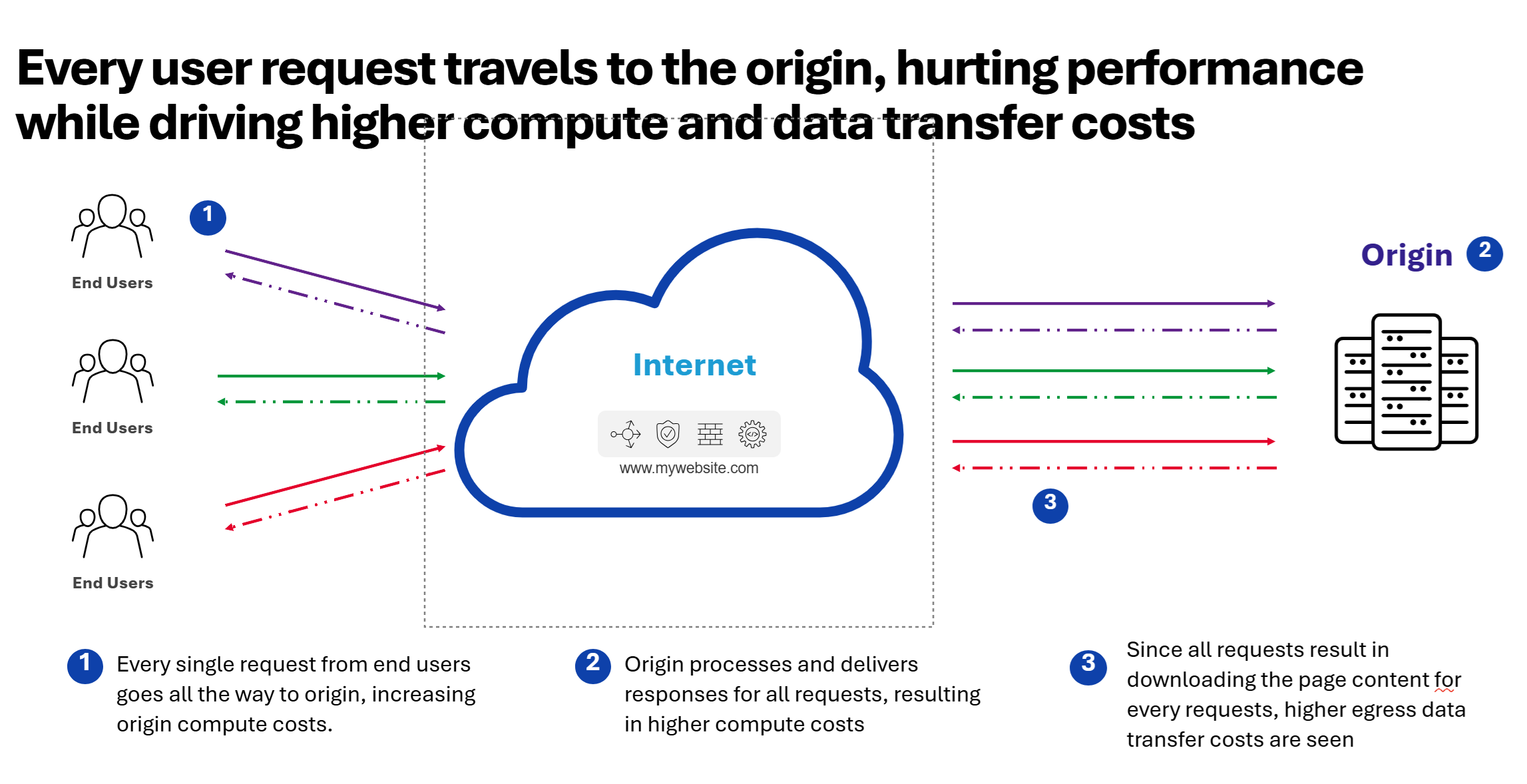
Figure: CDN Working
Without a CDN, every single user request travels to your origin infrastructure.
This results in:
- Higher latency and slower page loads for the end user
- High origin compute and egress data transfer costs
- Lower conversion rates
In a landscape where reliability, responsiveness, and confidence are critical, performance is not just a technical metric. It is a key driver of customer satisfaction, retention, and long-term business value.
A CDN is not an optional enhancement. It is a foundational component for delivering consistent, fast, and resilient digital experiences.
Content Delivery Networks (CDN)
A Content Delivery Network (CDN) is a globally distributed system. It is designed to improve the performance, reliability, and scalability of modern web applications.
CDN improves application delivery by caching and serving content from Points of Presence (PoPs). These PoPs are geographically closer to users. Requests are routed to the nearest edge node, significantly reducing latency. This ensures consistent performance across regions.
By offloading cacheable traffic from the origin, CDNs reduce compute load. They also lower bandwidth consumption and enhance availability during traffic surges.
The edge location serves as a natural enforcement point for security. It enables protection against DDoS attacks, blocking malicious bots, and applying Web Application Firewall (WAF) policies. Traffic is protected before it reaches the origin.
F5 extends traditional CDN capabilities by integrating performance, security, and delivery services. These are integrated into a unified platform. This eliminates operational complexity from maintaining separate systems for CDN and application security.
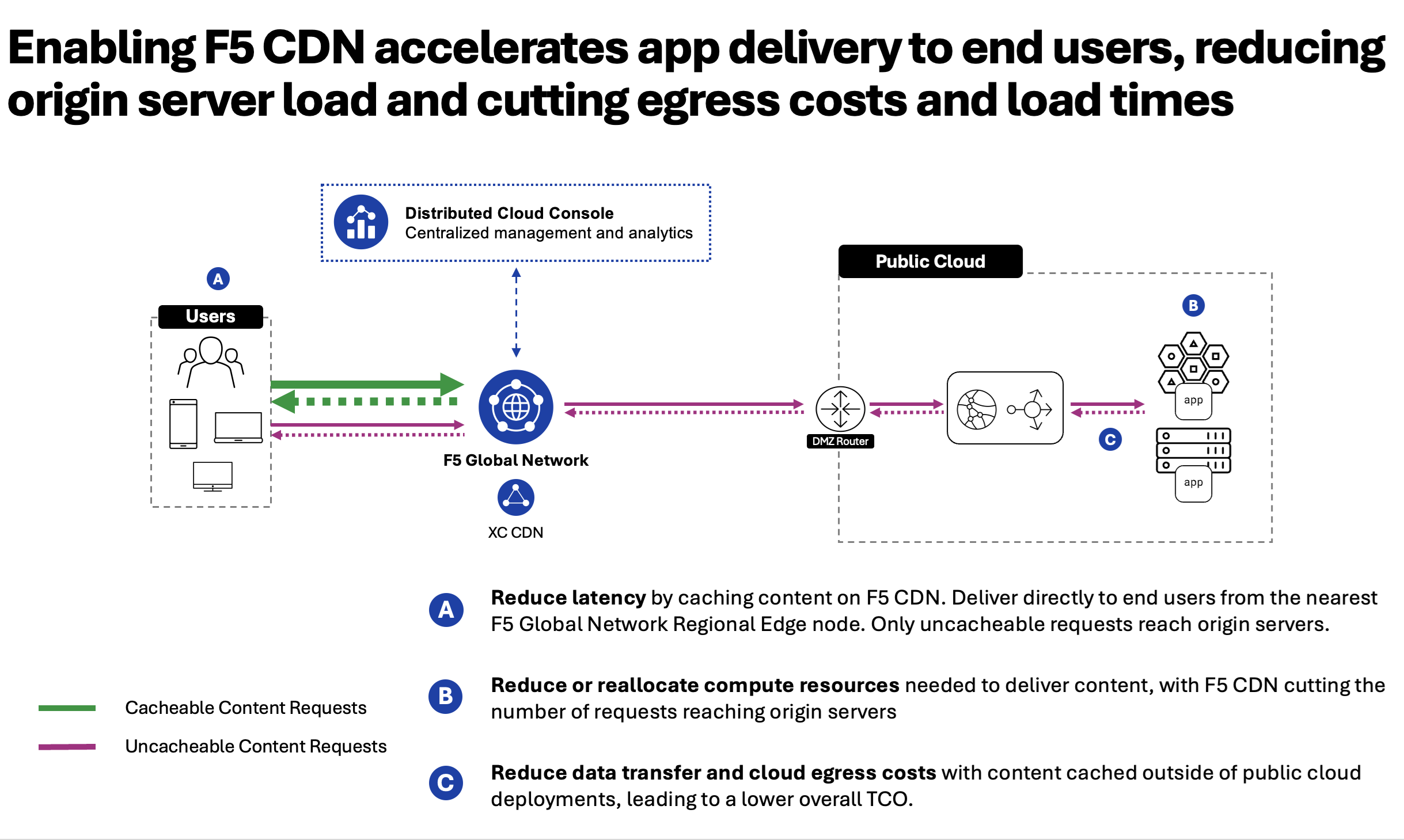
Figure: CDN Workflow
F5 Distributed Cloud CDN differentiates itself through operational simplicity and platform integration. Customers using F5 Distributed Cloud HTTP Load Balancer can enable CDN acceleration with a single click.
They can leverage built-in cacheability insights to estimate performance improvement and cost savings. This estimation occurs before activation.
Once enabled, cacheable content is served instantly from the nearest F5 edge node. Uncacheable requests are forwarded to the origin.
This approach results in:
- Faster load times
- Reduced origin traffic
- Lower egress costs
No rearchitecture, new deployments, or additional services are required.
By combining global caching, edge security, centralized observability, and frictionless enablement, F5 Distributed Cloud CDN delivers a comprehensive solution. It accelerates and secures applications across distributed user environments.
For environments requiring precision, granular traffic controls provide flexibility. You can selectively apply CDN enhancements across specific applications. They can also be applied to HTTP Load Balancer-served routes.
The platform also offers lightning-fast purge capabilities. Outdated or sensitive content can be removed globally in under a minute.
When teams need even greater control, granular cache policies allow fine-tuning. You can adjust cache keys, TTLs, and path or header-based rules.
All of this is complemented by rich observability. Unified dashboards provide real-time insights into traffic patterns, cache efficiency, and overall CDN performance. This empowers teams to optimize delivery with confidence.